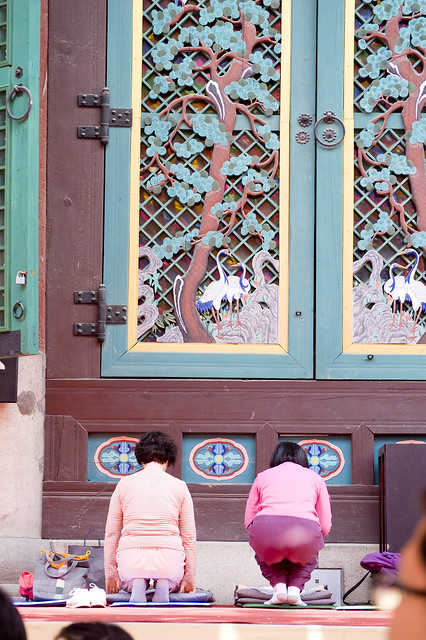
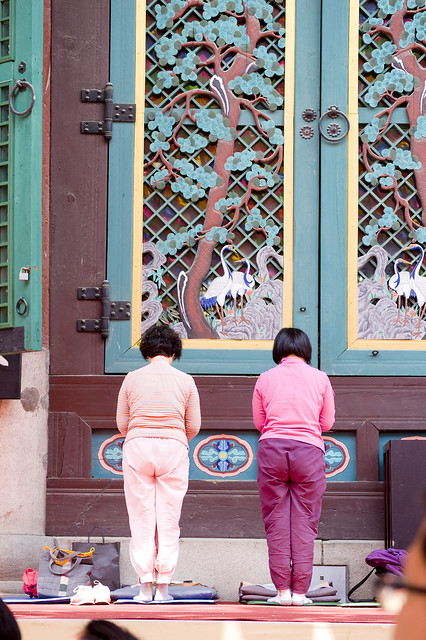
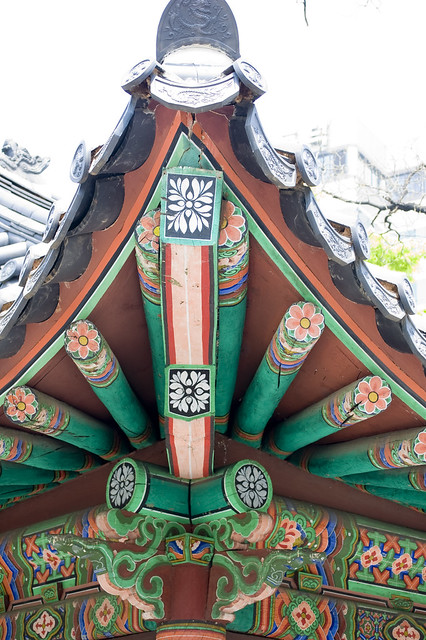
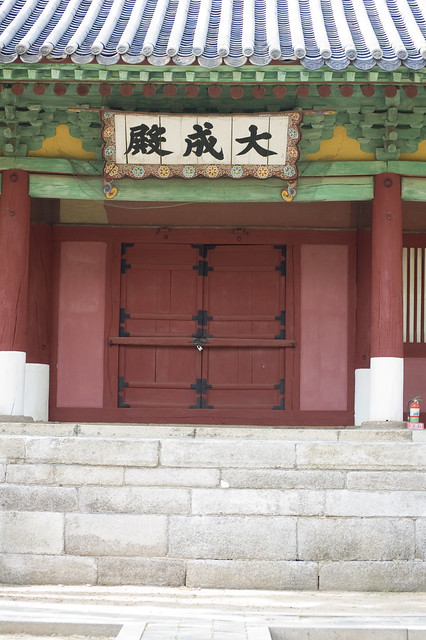
A couple weeks ago, we had the opportunity to spend the night at a Buddhist temple in what is called in Korean a "Templestay" (all one word). You dress, walk, behave, eat, pray and meditate like a monk for a night. First thing we did when we arrived was have a quick chat with the monk who was going to be our guide for the stay. We were served green tea by one of the female employees and as soon as she left us alone we were in scramble mode to make it look like we drank the tea (so as not to offend our hosts and make a big deal about it). It was shear madness trying to pour ten steaming cups of tea into three empty water bottles and then have to clean up the inevitably massive spillage. But our hosts came back and seemed none the wiser, even though there was still a sizable puddle of tea on the floor.
Next came the outfits. We were given grey novice "templestay" attire that made us look kind of like we were escaped convicts. On our way to the dining hall, we were asked to walk like monks - which means single file, hands clasped in front of you, and no talking. It looked like we were in a chain gang! Once in the cafeteria we followed the Buddhist manners for eating, which is to eat in silence and eat everything that you take. Inside the empty cafeteria with metal trays and complete silence we all had the same thought running through our heads: "It's like prison!". Eventually the monk came by to check on us and broke our silence (after that we were all more relaxed in our manners and talked out loud to each other).
After washing our trays we went to one of the Buddhist shrines and did some bowing. Then back in the templestay hall area, Dr. Peterson lead us in meditation time which we did for about a half an hour. And then it was bed time! Lights out at 9 PM. Which made sense considering that morning prayers began at 3 AM. Which we participated in (at least for a little bit). The rest of the morning involved some lecture from Dr. Peterson, free time, breakfast, and then getting ready to leave. By the time we left it was only 7 AM. Needless to say, the rest of the day (which included visiting a shipyard and getting treated to a VIP lunch) was a very long one.
Showing posts with label Buddhism. Show all posts
Sunday, June 19, 2011
Sunday, May 15, 2011
Hae-insa
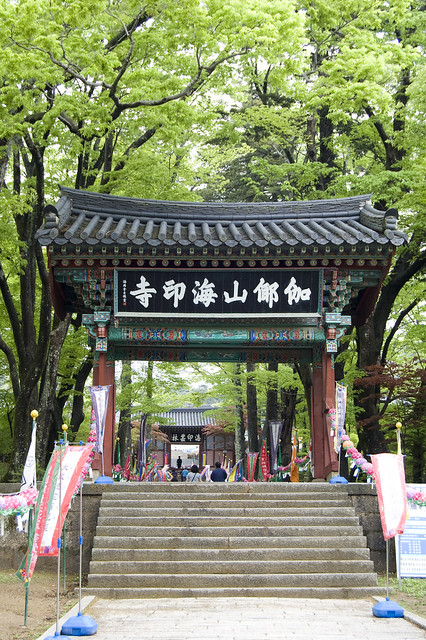
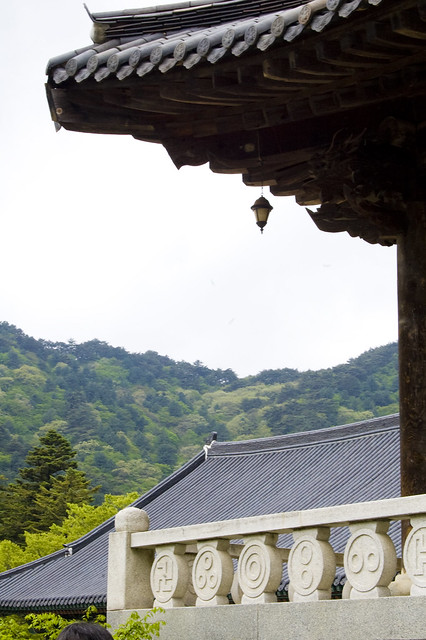
On Tuesday the 10th we went to Hae-insa (해인사) - it's one of the 3 treasure temples in Korea along with Tongdo-sa (통도사) and Seongyo-sa (성교사). The beauty of this place was almost destroyed during the Korean War. Major Kim Youngwan (김영환) was given the order to bomb Hae-insa but upon approaching the drop zone he decided to call off the attack because of his memories of coming to Hae-insa with his mother when he was a little boy. Instead he dropped the bombs elsewhere (probably in some rice fields) and returned only to be court marshaled for disobedience. He was imprisoned for the duration of the war - but luckily someone remembered him and decided he should be recognized for his patriotism in preserving Korean history. He was court marshaled again but was found innocent the second time and made a general.
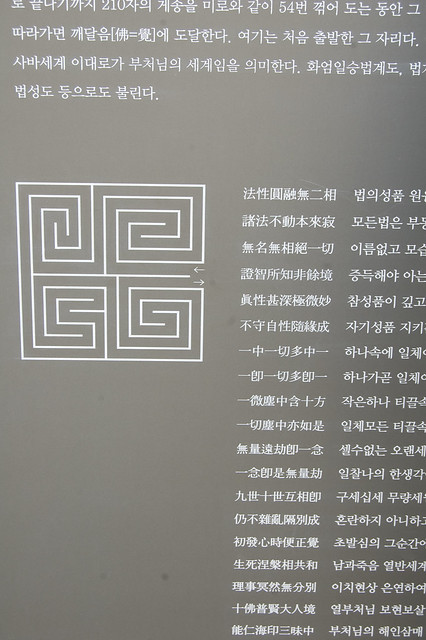
Within the temple there is a "maze" - originally there were just the words to a Buddhist poem written in such a way that the only way to follow the path was to be able to correctly read the verses. To make the path more accessible to the masses, the monks created a physical path that does not include the words of the poem, but they can be found on a plaque nearby in Chinese and Korean. Being able to walk through the maze is a form of meditation and many of the people visiting Hae-insa participated in it - as did we!
The temple at Hae-insa keeps the dharma (the law) on wooden blocks - this is part of the 3 baskets/treasures known as the Tripitaka. The other 2 treasures are the life of Buddha and how to live in the monastic order. The life of the Buddha is depicted through paintings all around the outside of one of the shrines, as well as in a mural-type painting inside. The man usually referred to as the living Buddha is Siddhartha Gautama, a Nepalese prince. The life of Buddha begins with his mother conception dream which involved a white elephant. When the Buddha was born, his mother gave birth standing up and holding on to a tree for support; rather than coming from the womb, the baby came from underneath her arm and was more like a miniature man than a baby. He stood upright and possibly declared something (Dr. P can't remember). As a young prince he went out about the city and saw 4 disturbing things: poverty, age, death and disease. This made him want to be more liberal in helping people overcome these things. His father wanted him to be conservative and concerned more with matters of state than social welfare. To escape the smothering influence of his father and seek out enlightenment, the Buddha and his servant climbed upon a white horse that flew over the palace walls. At first the Buddha tried aestheticism which involves extreme fasting, but it didn't work for him. Before obtaining enlightenment he was tempted by 3 beautiful women but because of his enlightened-ness he was able to see them as the ugly demons they were.
Saturday, May 14, 2011
Kyoung-joo: Seokkudam & Bulguksa
Okay, so it's getting to the point where I'm starting to be way behind on my blog posts and I don't have the time to tell you EVERYTHING that I'm learning. Which is unfortunate because it's all so fascinating. So I'll be brief with some of these posts, but I will be sure to include a few notable things.
After we visited the Wongsung tomb we had lunch (which was soft tofu stew - 순두부 찌게) and ice cream before getting in the car for some more driving up to the Buddhist temple called Seokkudam (석굳암). It was completed in 751 A.D. and is a UNESCO World Heritage site. Every Buddha has 33 unique symbols that identify the figure as a Buddha, including the knobby hair, long ear lobes and androgynous features. The temple at Seokkudam has been found to match the Golden Ratio, and the halo behind the Buddha appears as a perfect circle to viewers but because of the curve of the dome on which it lies it is actually an ellipsoid; architecturally it features a circle motif. We also learned that in Buddhism there are Bodhisattva's (보살) who are people who reach nirvana only to remain in mortality to help others achieve nirvana.
We had to wait in line a long time to get up to the temple and see the Buddha - but as soon as we got out everyone was gone! We managed to get up to the temple at the same time as a massive wave of visitors. Luckily our next stop, which was further down the hill, was not nearly so congested. This temple is called Bulguksa (불국사). Within the temple are many different elements: one that we saw at various temples is the four drums symbolizing water, air, land and spirits/the dead (technically this last one is a bell). By ringing/beating all of the drums the monks call all sentient beings to meditation.
The two pagodas pictured above are the the tabotap (타보탑) and sokatap (소카탑) respectively. The tabotap means many treasure pagoda and although it is made of stone it is cut as if it were wood. The sokatap is Buddha's pagoda and inside was found the oldest printed paper in the world. Further into the temple are various shrines to different major Buddhas including Avalokitesvana and Vairocana (there was a third one but I can't remember who it is). Each Buddha can be identified by his mudra or hand symbol (ex: one hand clasping other's first two fingers/one hand clasped over the other; thumb and middle finger forming circles in a kind of yin-yang formation apart/same formation only the circles are interlocked). Also included in Buddhist temples throughout Korea are evidences of shamanism which permeate Buddhism because of its popularity with the masses. While shamanism believes in many different kinds of spirits, the biggest one is the sanshin (산신). Monks do not like the sanshin at all, and often times sanshin shrines that used to be featured in temples have now been either eliminated or drastically demoted in prominence. For example at Bulguksa the sanshin shrine that used to be there has now been turned into a "disciples hall" and the sanshin shrine is just a painting in a corner of one of the other Buddha shrines. Because everyone still wants to worship the sanshin, you will find areas where there are TONS of little stone towers made by stacking flat-ish stones on top of each other from bigger to smaller. Our group had fun stopping to make our own sanshin stones.
Thursday, May 12, 2011
Children's Day
On the 5th of May we visited various Buddhist, historical and Confucian sites in Seoul. It was Children’s Day so the entire city was more active than usual.
Our first stop was a Buddhist temple in the midst of the hustle and bustle of the city. They had TONS of lanterns strung up and various activities for children (including a Korean clown and different kinds of arts and crafts). While standing outside the temple, Dr. Peterson explained the three treasures of Buddhism. They are: the Buddha (relics), the Dharma (scriptures), and the monastic order of the monks (상하). These treasures would come up again when we later visited Buddhist temples in southern Korea.
Nearby the temple was located a historical landmark – a post office actually – called the “central post office” or 우정총국. It was the first “modern” post office in Korea: “modern” meaning it dealt with domestic AND international mail. Korea had an established domestic postal system (aka Pony Express) long before Western civilizations or the U.S. Dr. Peterson went on to lament the poor description given on the plaque next to the post office. He explained that it failed to grasp the greater historical significance on top of presenting a biased account of the coup that was staged in the building during its inception ceremony dinner. Here’s the story (please forgive the brevity of this account as I am not nearly as knowledgeable or as good a story teller as Dr. P): The coup that took place was in 1884 and is known as Gamshinjeungyeon (감신정연). The Korean progressives wanted remove the reigning Min family, who were conservatives. The Progressives noticed the example of the Japanese Westernization movement and desired the same change for Korea. The goal was to kill the Min brothers who would be at the dinner held within the post office. Their strategy was to create a distraction by setting fire to a nearby thatched-roof house (which would pose a serious hazard to the whole neighborhood of thatched-roof homes) and in the ensuing commotion to put out the fire/escape, assassins would kill the Min brothers. On the night of the dinner, the Progressives worked to set fire to their targeted house, but because of straws high ignition temperature they were unable to light a successful fire. Eventually they set fire to a tile-roof house causing the dinner to end in a hubbub. In the end, only one Min brother was wounded but not fatally. The failed coup meant that Korea would not jump on the Westernization bandwagon with Japan. While the wounded brother’s injury was not initially fatal, subsequent medical treatment failed to successfully heal him – I’m not sure but I think the wound was probably infected. Anyways, King Kojong (코종) (his brother) worried his brother wouldn’t live and sought the professional help of the American physician Horace Allen. Allen was a surgeon as well as the chaplain at the U.S. embassy. After healing the wounded brother, Allen was asked by the king what he wanted for a reward. Allen asked that Western medicine be practiced in modern hospitals, which meant establishing a more modern school system for educating new Western doctors – and he added in churches on top of that (because he was a chaplain). This explains the prevalence of Protestant Christianity in Korea compared to other East Asian countries.
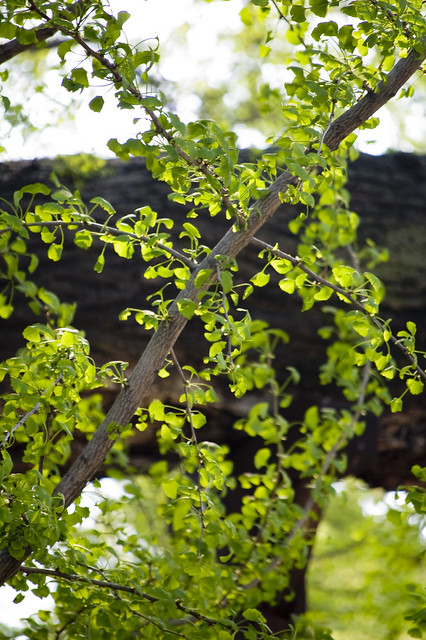
At the end of our day, Dr. Peterson took us to the Sun-gyun-gwang (선균관), the headquarters of Confucianism in Korea (at least that’s what I understood it to be). It was interesting to hear him talk about the importance of the gingko tree, which symbolizes the unity of opposites. Gingko trees are coniferous (like pine and fir trees) but unlike other conifers they are not evergreen. They are deciduous and lose their leaves each year. Dr. P also described the 3 bonds and 5 relationships of Confucianism. The 3 bonds are between:
- King and Subject
- Father and Son
- Husband and Wife
- Older and Younger
- Friend and Friend
- King – Subject = righteousness
- Father – Son = intimacy
- Husband – Wife = distinction
- Older – Younger = order
- Friend – Friend = trust
Much love from Korea XO
Subscribe to:
Posts (Atom)
Blog Archive
-
▼
2011
(27)
- ► 06/12 - 06/19 (1)
- ► 05/29 - 06/05 (8)
- ► 05/22 - 05/29 (3)
- ► 05/15 - 05/22 (4)
- ► 05/08 - 05/15 (8)
- ► 04/24 - 05/01 (1)
About Me
- Rachael Caldwell
- I'm a Senior at BYU studying Genetics and Biotechnology. Graduation is just around the corner -- time is flying by! This blog is for all my friends and family around the world who want to keep up with what I'm getting up to.
Powered by Blogger.